US-Ukraine Business Council

Content on this page requires a newer version of Adobe Flash Player.

Get Adobe Flash player

May 2012
S M T W T F S
29 30 1 2 3 4 5
6 7 8 9 10 11 12
13 14 15 16 17 18 19
20 21 22 23 24 25 26
27 28 29 30 31 1 2
 
UKRAINE BUSINESS NEWS - TWELVE ARTICLES

FDI Down 14.3% in 2010; New ways to lure investors; Mr. President, where's the FDI?; GDP to grow 6.5%; Public debt $54 billion; Amb Motsyk meets with U.S. businessmen; New Peace Crops volunteers; Annual appeal for the elderly;
Shell, ArcelorMittal, Vanco
U.S.-Ukraine Business Council (USUBC)
Wash, D.C., Tues, Dec 14, 2010

INDEX OF ARTICLES  ------
Clicking on the title of any article takes you directly to the article.              
Return to Index by clicking on Return to Index at the end of each article

1.  NET INFLOW OF FOREIGN DIRECT INVESTMENTS IN UKRAINE 14.3% DOWN IN NINE MONTHS OF 2010
Interfax - Ukraine Business, Kyiv, Ukraine, Tue, November 16, 2010

2NEW WAYS TO LURE IN INVESTORS
Two years of global economic crisis resulted in sharp decline in FDI into Ukraine
Commentary: by Tomas Fiala, Managing Director, Dragon Capital
Kyiv Weekly, Kyiv, Ukraine, Monday, December 6, 2010 

3BUSINESS: MR. PRESIDENT, WHERE'S THE FDI? 
Promises by President Viktor Yanukovych to boost investment into Ukraine have yet to bear fruit.
Mark Rachkevych, Kyiv Post, Kyiv, Ukraine, Sat, Nov 27, 2010 

4GOVERNMENT FORECASTS GDP WILL GROW TO 6.5% IN 2012-2013
Interfax Ukraine Business Express, Kyiv, Ukraine, Mon, Dec 13, 2010

5EXPERTS: PUBLIC DEBT WILL READY USD 54 BILLION BY END OF 2010
UkrInform - Economic News online, Kyiv, Ukraine, Mon, Nov 29, 2010

6AMBASSADOR OF UKRAINE TO THE USA OLEXANDER MOTSYK HOSTED 15TH ANNIVERSARY LUNCHEON OF U.S.-UKRAINE BUSINESS COUNCIL (USUBC) AND MET REPRESENTATIVES OF AMERICAN BUSINESS 
Embassy of Ukraine to the USA, Wash, D.C., Monday, Dec 6, 2010

7SEVENTY-NINE AMERICANS SWEAR IN AS PEACE CORPS VOLUNTEERS IN UKRAINE 

U.S. Peace Corps in Ukraine is largest one in the world
Ukrainian News-on-line, Kyiv, Ukraine, Thu, Dec 9, 2010 

8ANNUAL APPEAL FOR UKRAINIAN ELDERLY
Katie Fox, President, American Friends of Survival
Washington, D.C., Thursday, December 9, 2010

9SHELL HOPES TO RESTORE PARTNERSHIP WITH NAFTOGAZ IN HYDROCARBON EXTRACTION IN UKRAINE
Interfax Ukraine, Kyiv, Ukraine, Wed, December 8, 2010

10ARCELORMITTAL KRYVYI RIH APPOINTS STARKOV DIRECTOR GENERAL 
Ukrainian News Agency, Kyiv, Ukraine, Thu, Dec 9, 2010

11UKRAINE HOPES TO AVOID PAYING FINES IN AGREEMENT WITH VANCO
Interfax Ukraine, Kyiv, Ukraine, Thu, Dec 9, 2010

12BOOK LAUNCH: "UKRAINIAN ARTISTS IN PARIS, 1900-1939"
New book by Vita Susak of Lviv Art Gallery, Lviv launched in Wash, D.C.
U.S.-Ukraine Business Council (USUBC), Wash, D.C., Mon, Dec 13, 2010
========================================================
1NET INFLOW OF FOREIGN DIRECT INVESTMENTS IN UKRAINE 14.3% DOWN IN NINE MONTHS OF 2010
Interfax - Ukraine Business, Kyiv, Ukraine, Tue, Nov 16, 2010

KYIV - The net inflow of foreign direct investment in Ukraine January through September 2010 was $2.547 billion,which was 14.3% down on the same period last year,the State Statistics Committee has reported.

According to the committee,over the period foreigners made $3.423 billion in direct investment in Ukraine (13.3% down from 2009),but at the same time they withdrew $628 million (25.7% down).

Taking into account data for the first and second quarters,when the net inflow of investment was only $98.3 million and $397.5 million respectively (or 12% and 21.1% of the 2009 figures),the net inflow of foreign direct investment in the third quarter grew by $2.051 billion,which is 3.3 times up on 2009.

The total volume of foreign direct investment in Ukraine as of October 1 reached $42.512 billion,which is 6.4% up since the start of 2010. The committee said that foreign direct investment per capita was $926.70.

Over the period, the volume of investment from Cyprus grew by $620.5 million, from Sweden by $456.4 million, from Germany by $404.1 million, from Russia by $392.3 million, from the Netherlands by $128.5 million, from Luxemburg by $121.8 million and from France by $121 million.

Due to the sale of capital to non-residents from other countries and outflow of investment,the capital of investors from the United State fell by $88.8 million,from Iceland it fell by $29.3 million due to the sale of capital to non-residents from other countries,and by $21.6 million due to the exchange rate difference and capital outflow from Britain.

The sectors that saw the greatest increase in foreign capital over the period were financial companies ($1.684 billion),trade,auto repairs,domestic appliances and personal supplies ($237.6 million) and real estate, engineering and business services ($215.7 million).

Investment in Ukraine last year came from 124 countries. The largest investor countries,the total share of which was estimated at over 82% of the total investment,were Cyprus ($9.579 billion), Germany ($7.006 billion), the Netherlands ($4.083 billion), Russia ($2.956 billion), Austria ($2.667 billion), Britain ($2.287 billion), France ($1.752 billion), Sweden ($1.732 billion), the British Virgin Islands ($1.426 billion), and the United States ($1.218 billion).

Industrial enterprises received $13.488 billion (31.7%) of the total direct investment in Ukraine,including $12.026 billion in the processing industry and $1.129 billion in the extracting industry.

About $1.84 billion in direct foreign investment went into food,beverages and tobacco production,$5.657 billion into metallurgical and finished steel production,$1.193 billion into chemical and oil and chemical sectors,$1.156 into engineering industry,and $802.2 million into the production of other non-metallic mineral goods.

Financial institutions accumulated $14.115 billion (33.2%) in direct investment,for real estate,engineering and business services the amount was $4.535 billion (10.7%),and for trade,auto repairs,domestic appliances and personal items the sum was $4.455 billion (10.5%).

As of October 1,2010,Ukrainian companies received $5.913 billion in loans from direct investors. The largest amount of investment was received from Cyprus ($2.063 billion),Germany ($718.4 million),the Netherlands ($586.1 million),Britain ($293.8 million),Austria ($258.6 million),and France ($175.6 million).

Total FDI,including borrowed funds came to $48.424 billion as of October 1,2010. In January-September 2010,Ukraine made $640.5 million in direct investments in the economies of other countries,mainly in the form of monetary payments.

Ukraine made direct investment of $6.851 billion in other countries,including $6.539 billion in EU countries (95.4% of the total),$217.5 million in fellow CIS countries (3.2%) and other countries $95.3 million (1.4%). Ukraine made direct investments in 47 countries,particularly Cyprus (92.8%).

Loans from Ukrainian direct investors totaled $129 million on October 1,2010. Total direct investment in other countries,including loan capital,totaled $6.981 billion. 
----------------------------------------------------------------------------------------
[return to index] [U.S.-Ukraine Business Council (USUBC), www.usubc.org]
========================================================
2.  NEW WAYS TO LURE IN INVESTORS
Two years of global economic crisis resulted in sharp decline in FDI into Ukraine

Commentary: by Tomas Fiala, Managing Director, Dragon Capital
Kyiv Weekly, Kyiv, Ukraine, Monday, December 6, 2010 

KYIV - Two years of the global economic crisis have resulted in a sharp decline in foreign direct investments (FDI) into Ukraine, according to the State Statistic Committee. Over the period July 1, 2005 - July 1, 2006 the amount of FDI into Ukraine’s economy grew by US $9.32 bn - from US $9.06 bn to US $18.38 bn. By July 1, 2007 it had increased by another US $5.79 bn, i.e. up to US $24.17 bn, by July 2008 - a record sum of US $12.28 bn, reaching the level of US $36.45 bn

However, over the next 12 months, that is by July 1, 2009 the FDI grew by a mere US $1.52 bn - to US $37.97 bn, and by July 1 2010 it increased by US $2.43 bn totaling of US $40.4 bn. Meanwhile, the FDI increase over the first 6 months in 2010 was neglectable: US $495.8 mn, while the volume of FDI over this term made up US $1,782.8 mn.

The difference is explained mainly by a decrease in capital investments by non-residents of US $534 mn (due to a withdrawal of capital, re-assignment of capital to residents, etc.) and also taking into account fluctuations in foreign currency exchange rates, the negative effect of which was US $681.6 mn.

Among Ukrainian regions the leaders in FDI growth over the first 6 months in 2010 were Kyiv (US $721.5 mn) and the Dnipropetrivsk oblast (US $117 mn). The largest decrease in FDI volumes was observed in the Ivano-Frankivsk oblast (by US $125.1 mn).

[1] First of all, the increase in foreign capital was registered in companies engaged in financial activities (US $591.6 mn) and also those engaged in commerce and renovations (US $84.5 mn), metallurgical production and production of ready-made metal fabrics (US $73 mn) and real estate, leasing, engineering and rendering services for entrepreneurs (US $55 mn).

[2] At the same time, volumes of FDI into enterprises in the chemical and oil industry increased by US $159 mn, food processing industry - by US $50.4 mn and engineering - by US $48.9.

[3] The geographical structure of increases in FDI is no less significant. Over the first 6 months of 2010 the volumes of capital from Russia grew by US $323.4 mn, which constituted nearly 2/3 of the total increase in FDI into Ukraine (65.2%). US $300.8 mn of that amount can be attributed to companies engaged in financial activity. In particular, in May Sberbank of Russia increased the authorized capital of its subsidiary in Ukraine by UAH 1.47 bn (US $186 mn).

We can expect a continuation of Russian penetration into Ukrainian banking sector. At least in June, Director of the Strategy Department of Sberbank of Russia Dmitriy Tarasov said the bank has plans of purchasing one of the largest Ukrainian banks. The sum of the deal could be anywhere from US $1-5 bn, according to expert estimates.

Cyprus is in second place behind Russia in terms of the increase in FDI into Ukraine over the first 6 months of 2010 at US $150.7 mn. It is no secret that investments from Cyprus are in most cases virtually domestic investments, though they are transferred from companies registered in Cyprus.

Investments from Cyprus into Ukraine’s sector of non-financial operations and services increased by US $77.3 mn, US $75.7 mn were invested into metallurgy and US $44.9 mn - into the mining industry. At the same time, investments fell by US $46.7 in the chemical and petrochemical industries and by US $41.7 mn in the financial sector.

Moreover, the volume of FDI from Luxemburg increased by US $101.6 mn, from Kazakhstan - by US $97.4 mn and from France - by US $78.2. The capital volumes of U.S. investors decreased by US $89.6 mn and those of Greek investors - by US $45.5 mn at the expense of capital sales to non-residents from other countries and withdrawal of investments. In addition, investments from the UK fell by US $77.8 mn due to fluctuations in currency exchange rates and the withdrawal of foreign capital.

On the whole, FDI into Ukrainian industry in the first half year of 2010 fell by US $226.5 mn due to the exchange rate difference and the withdrawal of capital. In the only sector of industry in which a considerable growth, namely metallurgy, it was secured by investments from Cypress.

METALLURGY: GOVERNMENT SHOULD APPLY STIMULATING MEASURES
Clearly, in order to attract both foreign and domestic investments into metallurgy the government should apply stimulating measures.

As First Assistant Director of the National Institute of Strategic Studies Yaroslav Zhalilo pointed out, the traditional methods of state support such as indirect subsidies through low prices of raw materials, energy sources, gas, transportation services etc., devaluation of currency as a way of boosting export and financial and fiscal preferences for the sector may give a temporary stimulus, albeit fraught with a number of negative consequences.

In particular, such an approach does not create stimuli for increasing productivity, innovations, securing new markets and production of new types of products or the application of energy-saving technologies and may contradict the obligations Ukraine assumed upon being accepted to the WTO.

In Zhalilo’s opinion, instead the competitiveness of Ukraine’s metallurgy sector must be increased through tax breaks on revenues channeled towards reinvestment, tax breaks on the import of energy-saving equipments and special lines-of-credit for modernization. The expert says stimulating demand for metallurgy products on the domestic market is yet another imperative measure.

OBTAINING A PLOT OF LAND COULD TAKE UP TO THREE YEARS
Similar conclusions can be drawn in other sectors of industry, including agriculture. The HoReCa (hotel, restaurant and cafe) industry faces different problems. On the one hand, this is the unfavorable conditions for opening up a business: the legal registration of a plot of land requires nearly 160 permits and could take up to three years.

In terms of the indicator of the simplicity of being issued a permit for construction, Ukraine is in second to last place out of 182 countries according to statistics of the World Bank.

On the other hand, as the Director of the Human Development Research Department at the Institute of Demography and Social Research Larysa Lisohor, the share of employees with a higher education working for companies in the HoReCa sector (18%) is considerably lower than it is in the overall economy (30%) and the share of employees that go through professional training is 5-6 times lower than in other sectors of the economy.

Clearly, the shortage of qualified personnel has a negative impact on the quality of service and, accordingly, on the efficiency of labor in such companies. Meanwhile, only certain companies have the wherewithal to organize professional training of personnel.

At the same time, Lisohor says at the moment not a single division of the State Tourism Service and Resorts or the Ministry of Culture and Tourism are not engaged in the development of professional skills and personnel potential in the tourism industry.

HOTEL, RESTAURANT, CAFE AREA UNDERDEVELOPED
In short, this means the HoReCa sector in Ukraine is underdeveloped compared to EU countries, where it accounts for 4% of all employees (in Ukraine this figure is less than 1%).

Be that as it may, this comparison with the EU speaks of another factor: this sector in Ukraine has considerable growth potential, but in order for it to be realized the state must simplify the terms and conditions for investors to run a business and create stimuli for the development of a system of specialized education, i.e. learning courses and institutions.

The Ukrainian government's policies have grown more comprehensive and predictable since Viktor Yanukovych was elected president in February. This policy transformation owes to a large extent to the government's renewed cooperation with the International Monetary Fund.

The authorities' recent actions seem to demonstrate their continued strong adherence to cutting budget expenditures, reducing gas subsidies to households and implementing other austerity and structural reform measures demanded by the IMF under its $15bn 2.5-year loan program for Ukraine approved in July.

The increasingly likely postponement of next parliamentary elections until October 2012 will give the authorities a much needed breathing space to proceed with these unpopular but long overdue measures, particularly in the fiscal, pension and energy spheres, and those will definitely bear fruit if carried out as promised.

We currently expect Ukrainian GDP to grow by up to 5% in 2010 and 4.5% in 2011, making the country one of the fastest-growing in the CIS and Central and Eastern Europe.

----------------------------------------------------------------------------------------
[return to index] [U.S.-Ukraine Business Council (USUBC), www.usubc.org]
========================================================
U.S.-Ukraine Business Council (USUBC): http://www.usubc.org
From 22 to over 150 members in four years, join today
========================================================
3.  BUSINESS: MR. PRESIDENT, WHERE'S THE FDI? 
Promises by President Viktor Yanukovych to boost investment into Ukraine have yet to bear fruit.

Mark Rachkevych, Kyiv Post, Kyiv, Ukraine, Sat, Nov 27, 2010 

KYIV - Recent figures released show that promises by President Viktor Yanukovych to boost investment into Ukraine by bringing political stability and reforms have yet to bear fruit.

Due to domestic and global factors, foreign investors continue to steer clear of Ukraine, depriving the nation of much-needed stimuli that could fuel a rebound from a recession and pave the way for years of steady growth.

On Nov. 15, Ukraine’s State Statistics Committee reported that net foreign direct investment inflows were 14.3 percent down year-on-year in the first nine months of 2010, standing a mere $2.6 billion. That’s about four fold less than the FDI that is expected to pour into Poland this year.

A more optimistic picture was presented in October by Ukraine’s central bank. It announced then that net FDI stood at $3.6 billion in the first nine months of the year, which was 8 percent more than the same period last year.

FDI FLOW REMAINS MINISCULE COMPARED TO NEIGHBORING COUNTRIES
Up or down, economists say the FDI flow into Ukraine still remains miniscule compared to neighboring countries. Moreover, economists were quick to point out that about 35-40 percent of foreign direct investment inflows in 2009 and first nine months of 2010 were “forced" investments into the banking sector by foreign parent banks.

Still not lending in mass to individuals or corporate clients after a shaky 2009, foreign bank groups that control nearly half of the domestic market had little choice but to inject fresh cash to patch up local loan losses and meet the central bank’s capital regulations.

The mount of FDI inflows (into Ukraine) is not enough to speed up the economy's modernization," said Vitaly Vavryshchuk, an economist at the Kyiv office of BG Capital.

Moreover, “the bulk of FDI still comes via merger and acquisition deals and for bank recapitalization rather than into Greenfield projects," Vavryshchuk said referring to new projects that are more capital intensive and bring larger economic benefit.

In a geographic region slated to receive FDI of nearly $90 billion in 2010, according to the Vienna Institute for Economic Studies, Ukraine will only make up less than 1 percent of that share in eastern and central Europe.

BG Capital estimates Ukraine will receive $5.4 billion of FDI for the entire year. By comparison, Poland, Ukraine’s western neighbor with 12 million fewer people, is expected to collect $13 billion in FDI this year.

Since attaining independence in 1991, Ukraine has amassed $53.6 billion in FDI, the central bank reported. By comparison, Poland attracted close to $180 billion since 1990.

In a time when European governments - including Ukraine - are battling to slash budget deficits amid reduced tax revenue and economic shortfalls, Ukraine drastically needs to raise its attractiveness to foreign investors, lest not be bypassed.

UKRAINE RANKED LOW IN INTERNATIONAL RATINGS
“Just look at how Ukraine is placing on various international ratings," said Oleksandr Paskhaver, an economist at the Economic Development Center and non-staff consultant to the Harvard Institute for International Development. “Its ranking is at African levels in terms of ease of doing business, level of corruption and overall investment climate," he added. 

Andrew Mac, managing partner in Ukraine for Magisters, a leading Ukrainian law firm which has expanded to Russia and other CIS countries, said: “We saw a rapid decline in large scale investments from the onset of the financial crisis in 2008 through this year."

Mac added: “In Ukraine, the situation has been made worse due to political instability and an increasingly corrupt and inefficient regulatory and judicial structure. Currently, investors are relatively more content with political stability but concern with institutional corruption remains and discourage new investments. Although many are hopeful that some of the planned reforms will be addressed this next year."

The regional competition is tough for FDI. Ukraine is missing out on the much touted benefits of job creation, technology transfer, upgraded skills and competition.

What is seen in Ukraine by economists are a few big and lucrative industries, such as steel, energy and chemicals, where cozy local oligopolies keep prices unfairly high and market entry restrictive to the detriment of consumers and the overall economy.

"Foreign direct investment is critical for countries’ development, especially in times of economic crisis. It brings new and more committed capital, introduces new technologies and management styles, helps create jobs, and stimulates competition to bring down local prices and improve people’s access to goods and services," said Janamitra Devan, vice president  of financial and private sector development fo the World Bank Group.

Since taking over as president in February, Yanukovych has successfully cemented vertical control over all branches of government in Ukraine. Instead of bringing much-needed stability, some experts say his moves - increasingly deemed by as a step away from democracy - seem to be fueling a fresh round of political commotion and instability. Some fear such a scenario could derail reforms and scare away investment.

But if Yanukovych succeeds in delivering political stability and reforms - be it with an iron fist or through constructive compromises - investors could take a fresh look at Ukraine.

“Weaker investor confidence in Ukraine is due to the extended period of political turmoil and a sizable drop in economic activities," said BG Capital’s Vavryshchuk. “Investors need time to reassess threats and opportunities," he added.

Economist Paskhaver painted a gloomier picture. Yanukovych, he said, has thus far achieved nothing more than “bureaucratic order" for the benefit of his inner circle of political allies, supporting bureaucrats and oligarchs. This will not bring “economic stability" for the benefit of Ukraine’s economy and average citizens, according to Paskhaver.

According to Paskhaver, the more Yanukovych concentrates efforts on entrenching his vertical grip on power, the more he will erode public trust in government, the rule of law in Ukraine as well as long-term investor confidence.

Look at how the tax code was drafted. It wasn’t open. There was no real public debate. Investors look at this and say: better to stay away," said Alexander Paskhaver, economist.

"This isn't to say that reforms are bad or coming too slow.  It's just that the way they're being carried out does not correspond to what investors are used to seeing in more investor-friendly countries," Pashaver said.

NOTE:  Kyiv Post staff writer Mark Rachkevych can be reached at This e-mail address is being protected from spambots. You need JavaScript enabled to view it .

LINK:  http://www.kyivpost.com/news/business/bus_general/detail/91297/

NOTE:  The ISTIL Group/Kyiv Post, www.KyivPost.com, is a member of the U.S.-Ukraine Business Council (USUBC), Wash, D.C., www.USUBC.org.

----------------------------------------------------------------------------------------
[return to index] [U.S.-Ukraine Business Council (USUBC), www.usubc.org]
========================================================
4.  GOVERNMENT FORECASTS GDP WILL GROW TO 6.5% IN 2012-2013

Interfax Ukraine Business Express, Kyiv, Ukraine, Mon, Dec 13, 2010

KYIV - The Ukrainian government forecasts that the growth of Ukraine's gross domestic product (GDP) in 2012-2013 will accelerate to 6.5% every year, from 4.5% in 2011, according to the explanatory note to Ukraine's national budget for 2011.

"The expansion of investment and domestic consumer demand, and the higher efficiency of the use of production and financial reserves will ensure the growth of real GDP [rises to] 6.5% in 2012 and 2013," reads the note posted on the parliament's Web site.

According to the document, the forecast of Ukraine's economic development in 2012 and 2013 takes into consideration the influence of tax reform, the government's new social and economic policy aimed at invigorating the processes of national production modernization, an improvement in the business climate, the creation of favorable conditions conducive to investment, and the positive results of Ukraine's hosting the Euro 2012 European Football Championship finals.

The government's forecasts hold that inflation in 2012 and 2013 will slow to 7.9% and 6.2% respectively, down from 8.9% in 2011. The increase in real wages in 2012 and 2013 is foreseen at 6.4-6.5%, which is in line with real economic growth and the level of labor productivity (by 6% per year on average).

According to the note, the national budget deficit limit may fall to 2.5% of GDP in 2012 and 2% of GDP in 2013. The government also aims at stabilize the national debt at not more than 45% of GDP by the end of 2013 and 2014. The government also sees receipts from privatization in 2012 and 2013 at up to UAH 10 billion per year.
----------------------------------------------------------------------------------------
[return to index] [U.S.-Ukraine Business Council (USUBC), www.usubc.org]
========================================================
U.S.-Ukraine Business Council (USUBC): http://www.usubc.org
Promoting U.S.-Ukraine business relations & investment since 1995.
========================================================
5.  EXPERTS: PUBLIC DEBT WILL READY USD 54 BILLION BY END OF 2010

UkrInform - Economic News online, Kyiv, Ukraine, Mon, Nov 29, 2010

KYIV
- Ukraine's gross public and publicly guaranteed debt in October 2010 rose by 0.3%, to USD 51.2 billion, whereas in the first ten months of 2010 it grew by 28.7%.

According to the Sokrat investment group, an increase in public debt is expected. The debt amounted to 38.1% of GDP in October 2010, which was significantly below the 60% threshold for countries with transition economies.

Experts expect public debt to grow to USD 54 billion (40% of GDP) by the end of this year, including at the expense of USD 1.6 billion as the second tranche of a loan from the International Monetary Fund.

According to Oleh Ivanets, an analyst at the Art Capital investment group, after a four-month rally in June-September 2010, when the government increased public debt by USD 2 billion each month (loans from VTB and the IMF, VAT bonds and Eurobonds), in October, as expected, there was a full lull.

"As for projections, then we have slightly downgraded our forecast for public debt by the end of this year, from USD 55 billion to USD 54 billion. The reason is that the earlier announced plans to conduct an additional capitalization of banks (UAH 24 billion) were postponed because of disagreements in this issue with the IMF after reports in the media that a significant portion of funds earlier directed to recapitalize banks has been used improperly," Ivanets said.

At the same time, a loan of USD 2 billion will most likely not be returned to VTB this year, the expert said. Other important funds, namely, the next tranche of the IMF loan (USD 1.6 billion) and loans from the European Bank for Reconstruction and Development and other European institutions for EURO 2012 infrastructure projects (over USD 1 billion) are to be raised before the end of this year.

In particular, the European Bank for Reconstruction and Development allocated USD 450 million to Ukravtodor in November, and the company is to receive another USD 450 million as part of this project from the European Investment Bank.

Experts from Eavex Capital expect public debt to resume growth in the next two months, and, depending on the needs and appetites of the government, it will reach USD 52-55.5 billion by the end of 2010.

Even if the government decides to repay USD 2 billion received from Russia's VTB Bank, this should be compensated by the second tranche of the IMF, which is expected in December 2010, experts said.

In addition, the government may additionally place domestic bonds worth USD 2.5 billion in order to cover the budget deficit. Eavex Capital's experts also expect publicly guaranteed debt to rise by USD 0.6-1.2 billion at the expense of guarantees to state-owned companies, including to Ukravtodor.

As of September 30, 2010, Ukraine's gross public debt increased to USD 51.09 billion, from USD 48.305 billion as of late August 2010.
----------------------------------------------------------------------------------------
[return to index] [U.S.-Ukraine Business Council (USUBC), www.usubc.org]
========================================================      
6.  AMBASSADOR OF UKRAINE TO THE USA OLEXANDER MOTSYK HOSTED 15TH ANNIVERSARY LUNCHEON OF U.S.-UKRAINE BUSINESS COUNCIL (USUBC) AND MET REPRESENTATIVES OF AMERICAN BUSINESS 

Embassy of Ukraine to the USA, Wash, D.C., Monday, Dec 6, 2010

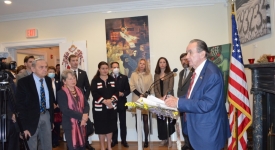
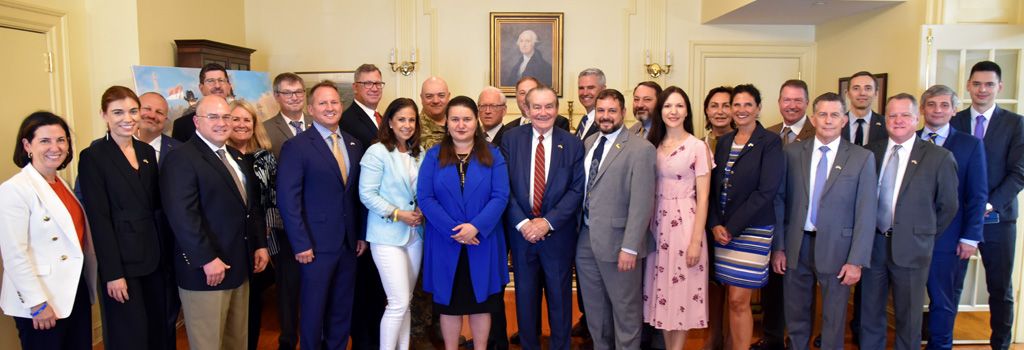
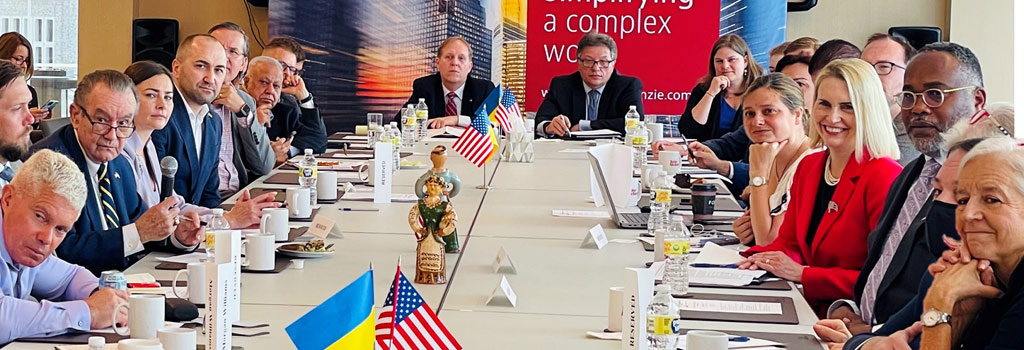
WASHINGTON, D.C. - On the 6th of December, 2010 the Embassy of Ukraine hosted the meeting on the occasion of 15th Anniversary of U.S.-Ukraine Business Council (USUBC). During this prominent event Ambassador of Ukraine to the U.S. Olexander Motsyk met with representatives of American business.

The meeting was attended by several dozen USUBC member companies, including Boeing, Cargill, Bunge, Case New Holland, Microsoft, DHL, Chevron, Citigroup, ExxonMobil and others.

The Ambassador of Ukraine informed the representatives of business about the pace of economic reforms in Ukraine focusing particularly on reforms in the energy and agricultural sectors. He also informed the audience about new legislation. Talking about new laws the Ambassador mentioned the adoption of the Law on Public Procurement, the new Tax Code, as well as the ongoing discussion on the draft the Air Code and amendments to the Labour Code.

Ambassador O. Motsyk highlighted improvements in the business environment, as well as the positive impact of political stability on reforms.  He stressed that progress was possible thanks to the political will of the President of Ukraine Viktor Yanukovych and the Government of Ukraine to bring business conditions in Ukraine to the best international standards.

In their comments representatives of U.S. companies admitted that despite the problems that still exist, the business situation in Ukraine improves steadily. The businessmen noted the effectiveness of meetings with the Ambassador of Ukraine as a mechanism of communication with the Government of Ukraine.

Ambassador of Ukraine Olexander Motsyk and President of the U.S.-Ukraine Business Council (USUBC) Morgan Williams agreed on establishing the practice of monthly meetings of the American business community with the Ambassador.

In addition, the USUBC management has agreed to providing assistance in arranging visits of the Ambassador of Ukraine to the U.S. regions to meet local businessmen. Future visits to Minneapolis/St. Paul, Chicago, Los Angeles, New York, Denver and Seattle were discussed.
 
LINK:  http://www.mfa.gov.ua/usa/en/news/detail/49944.htm
----------------------------------------------------------------------------------------
[return to index] [U.S.-Ukraine Business Council (USUBC), www.usubc.org]
========================================================
7.  SEVENTY-NINE AMERICANS SWEAR IN AS PEACE CORPS VOLUNTEERS IN UKRAINE 
U.S. Peace Corps in Ukraine is largest one in the world

Ukrainian News-on-line, Kyiv, Ukraine, Thu, Dec 9, 2010 

KYIV - Seventy-nine Americans have been sworn in as Peace Corps volunteers in Ukraine under the project Teaching English as a Foreign Language.

United States Ambassador to Ukraine John Tefft administered their oath. "We can be proud of the Peace Corps in Ukraine the biggest one in the world," he said.  The new volunteers promised to serve the strengthening of respect and friendship between the people of various nationalities and cultures.

The volunteers went through a ten-week preparatory training in Kyiv region and in Chernihiv region. They will be working in Ukrainian secondary schools, higher schools, normal schools and institutes of teachers' postgraduate education for two years.

In the opinion of Ambassador Tefft, this will help active study of the English language by teachers, pupils and students, and also achieve success in professional and career development.

United States Peace Corps Director for Ukraine Douglas Teschner, who was attending the ceremony, noted the event to be a very important step in the Ukrainian-American relations. "This is a very significant day for the relations of Ukraine and the United States," he said.

The U.S. Ambassador and Peace Corps Director thanked Ukrainian authorities for the assistance provided, and assured they would keep granting all-sided support to Ukraine further on.

As Ukrainian News earlier reported, the United States Peace Corps in Ukraine was founded in May 1992 by then presidents of Ukraine Leonid Kravchuk and of the United States George Bush. It is financed from the American taxpayers' money. In Ukraine the Peace Corps works in three areas: teaching English, developing communities, and developing youth.
---------------------------------------------------------------------------------------
[return to index] [U.S.-Ukraine Business Council (USUBC), www.usubc.org]
========================================================
NEWS: FOR THE LATEST NEWS CHECK OUT THE KYIV POST,
KYIV POST: A member of USUBC, LINK www.KyivPost.com 
========================================================
8.  ANNUAL APPEAL FOR UKRAINIAN ELDERLY

Katie Fox, President, American Friends of Survival
Washington, D.C., Thursday, December 9, 2010

WASHINGTON, D.C. - The following is the annual appeal letter from Katie Fox, President, American Friends of Survival, on behalf of the poor elderly in Ukraine.   

Dear Friends,
 
Happy holidays to all!  As the year ends, I am once again writing to ask you to consider sponsoring an elderly Ukrainian next year.  As most of you know, I run a small charity that helps poor elderly Ukrainians buy food, medicine and other necessities.
 
A donation of $240 or $20 per month will help one Ukrainian pensioner cover basic needs - warm clothing, food, medicine, and hospital bills, throughout 2011.  Ukrainian elderly continue to struggle with the effects of the global economic crisis. Inflation has led to a nearly 40% drop in the value of the currency, the hryvnia.

Those on fixed incomes have been hard hit, especially in Kyiv, an increasingly high priced European city. Our Kyiv pensioners receive the equivalent of between $114 and $195 per month to cover food, clothing, housing and medical costs. Yet food alone costs $150-170/month. 
 
The charity is entirely volunteer run and has no overhead costs – every cent you donate goes directly to an elderly recipient.  We are a small organization with a lot of oversight, another guarantee that your donation will be well spent.   Your contribution is entirely tax deductible.
 
I have attached a brochure with more information on “For Survival,” including how we screen recipients and use donated funds.  For more information please feel free to contact me at This e-mail address is being protected from spambots. You need JavaScript enabled to view it  or by cell phone 240-423-8845. Or, visit our web site at www.forsurvival.org
 
Please consider a donation today!  Your money will be well spent and deeply, deeply appreciated. To give safely online visit us at www.forsurvival.org
Or, checks may be made out to “For Survival” and sent to me at 5333 42nd St. N.W., Washington, D.C. 20015.
 
Thank you very, very much.
 
Katie
 
Katie Fox, President
American Friends of for Survival
5333 42nd St. N.W. , Washington, D.C. 20015
American Friends of “For Survival” is a registered 501(c)(3) nonprofit organization.  All contributions are tax deductible.

LINK: http://www.usubc.org/site/recent-news/re-annual-appeal-for-ukrainian-elderly

FOR SURVIVAL INFORMATION BROCHURE: http://www.usubc.org/site/files/For_Survival_Brochure_2010.pdf

---------------------------------------------------------------------------------------
[return to index] [U.S.-Ukraine Business Council (USUBC), www.usubc.org]
========================================================
9.  SHELL HOPES TO RESTORE PARTNERSHIP WITH NAFTOGAZ IN HYDROCARBON EXTRACTION IN UKRAINE

Interfax Ukraine, Kyiv, Ukraine, Wed, December 8, 2010

LONDON - Shell has confirmed its readiness to invest $100 million in hydrocarbon exploration and extraction in Ukraine under an agreement on cooperation signed with National JSC Naftogaz Ukrainy in 2005 and hopes that partnership of the two companies will become closer.

"We confirm our liabilities to invest $100 million in extraction. This is the sum that we promised to invest jointly with Ukrgazvydobuvannia [a subsidiary of Naftogaz Ukrainy]," Patrick Van Daele, the general manager of Shell Ukraine Exploration and Production, told Interfax-Ukraine in London on Tuesday.

He said at a conference dedicated to Ukraine and organized by the Economist newspaper, together with the Foundation for Effective Governance that the result of the agreement on partnership in hydrocarbon exploration and extraction signed with Naftogaz in 2005 on parity terms is very small: around $1 million has been invested.

"I see a small appetite for the partnership: progress with Naftogaz is less than we expected," Daele said. He said that the leadership of Naftogaz Ukrainy changed with each government reshuffling, so time was needed to meet with new managers and convince them of benefits of cooperation.

He said that relations with the present leadership of the holding are becoming more and more business-like. He said that Naftogaz needs partnership with large international oil and gas companies, as it allows it access to technologies, financial resources and western standards of doing business.

Daele said that Shell was the first large international oil and gas company to enter Ukraine, although the results of hydrocarbon exploration and extraction are less than expected.

He added that the results of Shell's work in the retail business had exceeded its expectations: the company's share of the market is 6%, and the company plans to increase it to 10-15%.

"We continue growing as quickly as the situation on the market allows," he told Interfax-Ukraine. He added that Shell did not change its investment strategy towards Ukraine during the financial crisis.

As reported, Naftogaz Ukrainy and Shell Exploration & Production Services (RF) B.V. signed an agreement on cooperation in December 2005. According to the agreement, Shell is to work on 10 fields with licenses belonging to Naftogaz Ukrainy.

NOTE:  Shell is a member of the U.S.-Ukraine Business Council (USUBC), Washington, D.C., www.USUBC.org.
---------------------------------------------------------------------------------------
[return to index] [U.S.-Ukraine Business Council (USUBC), www.usubc.org]
========================================================
10.  ARCELORMITTAL KRYVYI RIH APPOINTS STARKOV DIRECTOR GENERAL 

Ukrainian News Agency, Kyiv, Ukraine, Thu, Dec 9, 2010

KYIV - Shareholders of the ArcelorMittal Kryvyi Rih mining and metallurgical plant (Dnipropetrovsk region) at their meeting on December 9 appointed Rinat Starkov to the post of director general. A well-informed source announced this to Ukrainian News. Starkov has been acting director general of ArcelorMittal Kryvyi Rih since August 2, 2010.

Before, Starkov was a member of the board at Mondi Europe&International (Vienna, Austria), an integrated packaging and business paper producer, where he was responsible for the CIS markets, logistics and supplies, and before this he had chaired the board of directors at Mondi Business Paper Syktyvkar LPK, one of Russia's major paper and pulp manufacturers.

Starkov graduated from the Moscow State Institute of International Relations, specialty International Economy, and also got an MBA degree at Clemson University, United States.

As Ukrainian News earlier reported, the Arcelor Mittal Kryvyi Rih mining and metallurgical plant in July 2010 dismissed Jean Jouet as director general. Jouet has worked as the director general of the enterprise since January 2008.

Mittal Steel Germany GmbH owning 95.1266% in the plant is part of the Arcelor Mittal international holding. Arcelor Mittal Kryvyi Rih is Ukraine's biggest rolled steel producer specializing in long-length rolled steel production, in particular, the production of rod iron and fittings.

NOTE:  ArcelorMittal is a member of the U.S.-Ukraine Business Council (USUBC), Washington, D.C., www.USUBC.org.
----------------------------------------------------------------------------------------
[return to index] [U.S.-Ukraine Business Council (USUBC), www.usubc.org]
========================================================
U.S.-Ukraine Business Council (USUBC): http://www.usubc.org
Promoting U.S.-Ukraine business relations & investment since 1995.
========================================================
11.  UKRAINE HOPES TO AVOID PAYING FINES IN AGREEMENT WITH VANCO

Interfax Ukraine, Kyiv, Ukraine, Thu, Dec 9, 2010

KYIV - Ukraine hopes that its amicable agreement with Vanco Prykerchenska Ltd. would not foresee the compensation of the loss the company saw due to the cancelation of a production sharing agreement (PSA) on the exploration and extraction of oil, gas, gas condensate on the Prykerchensky field on the Black Sea shelf. Ukrainian Environment Minister Mykola Zlochevsky said this while speaking to the press in Kyiv on Wednesday.

He said that five issues are to be settled for the signing of the amicable agreement. The issues are associated with compensation for the losses by Ukraine. "We're working on the issue, so that Ukraine do not have to pay [the fine]," the minister said.  Zlochevsky also expressed hope that by late 2010 the amicable agreement would be signed and Vanco would start operating on the shelf.

As reported, the Stockholm Arbitration Tribunal has put off until December 31, 2010 hearings on a case on the renewal of licenses owned by Vanco Prykerchenska Ltd (the British Virgin Islands) for the development of the Prykerchenska oil and gas field on the Black Sea shelf and a production sharing agreement.

This was stated in the prospectus of an issue of eurobonds by state-run company Financing of Infrastructural Projects, which were issued against state guarantees. "If the sides fail to strike an amicable agreement before December 31, 2010, arbitration litigation could restart," reads the prospectus.

As reported earlier, the Stockholm Arbitration Tribunal set a deadline for signing an amicable agreement of September 30. Later the sides asked the arbitration tribunal to extend the deadline.  Ukraine's First Vice Premier Andriy Kliuyev previously expressed hope that the amicable agreement might be signed by the end of 2010.

Ukraine announced a competitive tender for the right to enter into production sharing agreements (PSAs) for the extraction at the Prykerchensky field of the Black Sea continental shelf in December 2005. Vanco International, 100% owned by Vanco Energy Company (United States) won the tender in April 2006.

It took more than a year to agree on a draft PSA, which was finally adopted by the government in October 2007 and signed in the presence of the former President Viktor Yuschenko.

The Environment Ministry in December 2007 issued a license to Vanco Prykerchenska for geological prospecting, research and the commercial production of oil, gas and gas condensate at the Prykerchensky field.

Later, the ministry found that a number of violations of Ukrainian laws were committed during the tender and when the license was issued to Vanco Prykerchenska, as well as evidence of infringements by Vanco International of some PSA clauses.

In April and May 2008, the government cancelled the license of Vanco Prykerchenska and withdrew from the PSA. Vanco went to the international arbitration, simultaneously offering the renewal of cooperation under the PSA to the government of Ukraine.

Vanco Prykerchenska is owned in equal shares by Vanco International, DTEK Holdings Limited of Ukrainian businessman Rinat Akhmetov, Shadowlight Investments Limited of Russian businessman Yevgeniy Novitsky, as well as Integrum Technologies Limited.

NOTE:  Vanco Exploration Company is a member of the U.S.-Ukraine Business Council (USUBC), Washington, D.C., www.USUBC.org.
----------------------------------------------------------------------------------------
[return to index] [U.S.-Ukraine Business Council (USUBC), www.usubc.org]
========================================================
NEWS: FOR THE LATEST NEWS CHECK OUT THE KYIV POST,
KYIV POST: A member of USUBC, LINK www.KyivPost.com 
========================================================
12.  BOOK LAUNCH: "UKRAINIAN ARTISTS IN PARIS, 1900-1939"
New book by Vita Susak of Lviv Art Gallery, Lviv launched in Wash, D.C.

U.S.-Ukraine Business Council (USUBC), Wash, D.C., Mon, Dec 13, 2010

WASHINGTON, D.C. - A important new book, "Ukrainian Artists in Paris, 1900-1939," by Vita Susak of the Lviv Art Gallery, in Lviv, Ukraine was launched at a reception sponsored by The Washington Group (TWG), www.TheWashingtonGroup.org, and the U.S.-Ukraine Business Council (USUBC), www.usubc.org, in cooperation with the Embassy of Ukraine to the USA in Washington, D.C., Friday, December 10, 2010.

"Ukrainian Artists in Paris, 1900-1939," is the first systematic and comprehensive examination of the role and substance played by Ukrainian-born emigres to France in this time period. A great deal has been written about this time and place, this great cultural upheaval that changed so much in the world of art, but the Ukrainian contribution to that time and place has rarely been imagined. Until now. 

Vladyslava Bondarenko, Counselor, Cultural Section, Embassy of Ukraine, welcomed over 50 guests to the Embassy.  Andy Bihun, President, The Washington Group (TWG) and Morgan Williams, Director, Government Affairs, Washington Office, SigmaBleyzer Private Equity Investment Group, who serves as President of the U.S.-Ukraine Business Council (USUBC), brought opening remarks about the ongoing work in the USA to promote Ukrainian art and culture. 

LIDIA LYKHACH, DIRECTOR, RODOVID PRESS
Lidia Lykhach, director of Rodovid Press, Kyiv, Ukraine, www.rodovid.net, who published the book, made a presentation about her long-time work to publish individual monographs about the history of Ukrainian art.  Rodovid has published twelve books already on this subject and more are planned.

Rodovid director Lykhach said the book has been published in Ukrainian and English.  A French-language version is being prepared in collaboration with the Institute francais d'Ukraine in Kyiv and will be published soon according to Lidia.  Lidia then introduced the author of the book, Vita Susak, Lviv, Ukraine.

AUTHOR VITA SUSAK
Author Vita Susak said she started doing the research for the book in 1998 with a trip to Paris.  Vita outlined her research that was conducted over the past 11 years and about the importance of the Ukrainian artists who worked in Paris.  Vita told about her work in libraries, galleries, museums, with some of the artists, with the families of those who had died and with private collectors.

Susak said this is the first detailed look at the contribution of artists from Ukraine to the phenomenon known as the “School of Paris.”  At the same time that Picasso, Modigliani and Chagall were working in Paris, many artists from Ukraine were also living and creating art there, among them Alexander Archipenko, Mykhailo Boichuk, Sonia Delaunay, Sophia Lewitska, Vladimir Baranoff-Rossiné, and Hannah Orloff. 

In the early 1920s they were joined by Oleksa Hryshchenko (Alexis Gritchenko), Mykhailo Andriienko, Vasyl Khmeliuk, and many others - some achieved fame, others are long since forgotten. Separate chapters are devoted to several of these artists. 

Ukrainian events that took place in the French capital are discussed against the general background of the “School of Paris.”  The book’s Appendix includes a dictionary of Ukrainian artists in Paris featuring more than 250 individuals, as well as a chronology of Ukrainian events in Paris, both covering the years 1900-1939.

"Vita Susak's book is groundbreaking because it shows art of Ukrainian origin in its various aspects within the framework of what is always called the School of Paris.  She recreates the cultural context in which artists of Ukrainian background worked and outlines the more important biographies. Her book should serve as a reference work," Jean-Claude Marcade, Le Pam, France, wrote in the Forward to the book.   

ABOUT RODOVID PRESS
Rodovid Press, Lidia Lykhach, Director, specializes in publications on the cultural history and heritage of Ukraine. Included are albums, monographs, and calendars, and a special Art Series. Most of their future publications will be in at least two languages: separate editions of Ukrainian and English, or French, or German.

They work cooperatively with authors and partners in specific projects and are always interested in acquiring new texts. Please contact Rodovid to discuss ideas concerning your publishing project

Among their most recent publications are such important works as Transformation in "Civil Society: an Oral History of Ukrainian Peasant Culture in the 1920-30s," "Embroidery of the Cossack Elite," the album "Ukrainian Folk Icons" and other. They are also proud to be working with the New York Group – poets, dramatists and novelists who publish with RODOVID PRESS.

PURCHASE OF RODOVID PRESS BOOKS
Books published by Rodovid Press can be purchased through the Rodovid Press website: http://www.rodovid.net/ or by contacting the Rodovid Press office in Kyiv, Ukraine, at 067 404 402 or e-mail This e-mail address is being protected from spambots. You need JavaScript enabled to view it .

LINK:  http://www.usubc.org/site/recent-news/book-launch-ukrainian-artists-in-paris-1900-1939

----------------------------------------------------------------------------------------
[return to index] [U.S.-Ukraine Business Council (USUBC), www.usubc.org]
========================================================


KyivPost

Aerosvit

Ukraine International Airlines

SigmaBleyzer

Dunwoodie Travel Bureau

Nibulon 20 Years! Congratulations!

Ukrainian Agrarian Confederation (UAC)

InterContinental Kyiv

MEEST America Inc

Ukraine Macroeconomic Report

People First

People First Democracy Watch Bulletin

TBF Investor Setiment Survey

Fluent in OPIC

Time for Reforms

MAKING UKRAINE STRONGER POST-CRISIS

Economic Development Forum

Ukrainian Agriculture

Express Operators Report

Software Piracy Report

Action Ukraine Report Subscribe

Action Ukraine History Report