
US-Ukraine Business Council

Content on this page requires a newer version of Adobe Flash Player.

Get Adobe Flash player

May 2012
S M T W T F S
29 30 1 2 3 4 5
6 7 8 9 10 11 12
13 14 15 16 17 18 19
20 21 22 23 24 25 26
27 28 29 30 31 1 2
 
AMB JOHN TEFFT: WE DO NOT SUPPORT THE POLICY OF SPHERES OF INFLUENCE

AMB JOHN TEFFT: WE DO NOT SUPPORT THE POLICY OF SPHERES OF INFLUENCE"We support the sovereignty, independence, and territorial integrity of Ukraine."
Interview with John Tefft, U.S. Ambassador to Ukraine
Interviewed by Mykola Siruk, The Day
The Day Weekly Digest in English #4
Kyiv, Ukraine, Thu, January 28, 2010


AMB JOHN TEFFT: WE DO NOT SUPPORT THE POLICY OF SPHERES OF INFLUENCE 
"And we support the sovereignty, independence, and territorial integrity of Ukraine."

Interview with John Tefft, U.S. Ambassador to Ukraine 
Interviewed by Mykola Siruk, The Day
The Day Weekly Digest in English #4, Kyiv, Ukraine, Thu, Jan 28, 2010

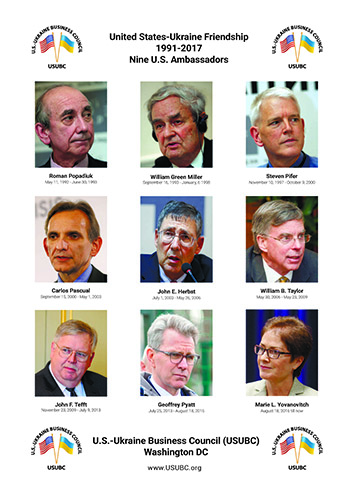
KYIV - The newly appointed US Ambassador to Ukraine, John TEFFT, is a top-notch diplomat with a huge working experience in countries of the post-Soviet space.

During his 37-year long career as a diplomat, he held the “second job” in the US Embassy in Moscow, and headed US diplomatic offices in Lithuania and Georgia. Previously, working as the assistant of the Deputy Assistant Secretary of State for European Affairs, Tefft was responsible for US diplomatic liaisons with Russia, Ukraine, Moldova, and Belarus, as well as matters pertaining to non-proliferation and weapons control.

The question remains as to what are the main issues on the ambassadors agenda? And, how will the results of the upcoming presidential election influence cooperation between Washington and Kyiv?

Below find answers to these questions in The Day’s exclusive interview with US Ambassador to Ukraine, John Tefft.

[THE DAY] Mr. Ambassador, this past Wednesday marked one year since the current U.S. Administration took over the reins. Can you name some foreign policy successes of President Obama during this year?

[AMBASSADOR TEFFT] “First, I would say that President Obama has changed much of the atmosphere, and he has changed that not only through his speeches, but by changing a number of positions. I think it is pretty obvious to people, the engagement that we have made on climate change issues, not just the positions that the United States has taken, but also the role President Obama personally took in Copenhagen to try to get results.

"Now, we know that this is still a work in progress, but I think it’s significant. I think we’ve tried very hard to do a number of other things which, to be sure, are slightly different than the Bush administration. The President is going to close Guantanamo. This is not easy to do.

"Everybody understands and knows that. It is going to take a little more time than they thought. But it is an example of the kind of thing that the President feels very strongly undercuts America’s image and position in the world. As he also said recently it actually is used by Al-Qaida as a way to recruit people. 

“There are a number of other areas where we have launched initiatives which are still not complete. Obviously, in this part of the world, people look at the reset policy with Russia. There are several issues with work still in progress. There is the START treaty that is still being negotiated.

"As someone who has worked on a lot of arms control in the past, I am not surprised it’s taken a little longer than people had hoped. There is a number of other things that we have done with Russia that relate to the reset, for example, shipping equipment to Afghanistan via Russian air space.

"We are working with Russia and China and our European Allies on the Iran threat and nuclear proliferation. Again, this is still a work in progress. It is an important security issue for everybody, not just the countries that are permanent members of the Security Council. It is a threat to international security, if Iran gets a nuclear weapon.

"Anyway, there are a lot of other efforts that are ongoing: Afghanistan and Pakistan, former Senator Mitchell’s work in the Middle East. These are tough problems that have been around for a long time and the Administration has put some new energy into them.”

[THE DAY]  How you can explain headline in American newspapers speaking about Obama’s decline, lack of audacity and losing allies in Eastern Europe?

[AMBASSADOR TEFFT] “I think the President has laid out his policy very clearly. I think everyone recognizes that there was some concern initially in Central and Eastern Europe among many of our friends about the reset policy, but I think both the President and the Vice President have tried to be very clear about that - not just when the Vice President visited here, but when President Obama was in Moscow, he was very clear in saying that we do not accept spheres of influence.

"He also said that state sovereignty must be a cornerstone of international order. The President added that, ‘just as all states must have the right to choose their leaders, states must have the right to borders that are secure, and to their own foreign policies…and any system that cedes those rights will lead to anarchy.

"That’s why we must apply this principle to all nations – and that includes nations like Georgia and Ukraine.’ Anyway, I think the President is working very hard. Probably the most important issue with regard to the success of the first year is the world economy. The President took huge risks in trying to work with our Central Bank to stabilize not only our economy, but the international economy.

"We were poised to experience the worst economic crisis since the Great Depression. And, while it has been bad - certainly bad here in Ukraine, where people are suffering; 14 percent contraction in GDP - it could have been much worse had there not been urgent and quick leadership.”

[THE DAY] Many experts think that the U.S. Administration’s announced “reset” of relations with Russia is not yielding results as expected. They point out that democratic and authoritarian regimes have little in common, leaving alone that their interests are largely opposite, and they talk different languages.

While the United States, in the words of its President and Secretary of State, talks about a multi-partner world, Russian leaders insist on a multi-polar world. Even in negotiating the new START treaty, there are problems, and the Russian Prime Minister started talking about developing offensive weapons to counter the U.S. anti-missile defense initiative. What is your comment?

[AMBASSADOR TEFFT] “START is a subject of very serious negotiations right now. Our main negotiator, Rose Gottemoeller, is my personal friend, and I know she is working extremely hard to get this done. I think we have been very clear from the President and Vice President on down that we have some serious differences with the Russians over the way they conduct relations with their neighbors.

"The Administration has been quite clear about the Russians in Georgia, and we have been very clear in stressing our support for the sovereignty, independence and territorial integrity in all of these countries, including Ukraine. That’s not just something said in public, it’s something that’s discussed in private. And, you know, we are going to disagree on that.

"But I think that the Administration’s effort is to try to focus on some of those areas where we can do something productive with Russia, such as Iran, nuclear proliferation, Afghanistan and terrorism, strategic arms – we need to work together on those issues even as we are very candid about our differences with Russia on other issues.”

[THE DAY]  Understandably, you cannot criticize your President – or maybe you can…but isn’t the “reset” of U.S.-Russia relations policy in contradiction to what you have been doing at your previous assignments and, probably, are going to continue here in Kiev – containing the Russian expansion in the post-Soviet territories? You have been called a specialist in containing Russian expansion.

[AMBASSADOR TEFFT] “I support President Obama and I don’t have any problem at all with the “reset” of U.S.-Russia relations. If you go back in my career, you will see that I worked in the 1980’s on arms control issues. I also worked very hard on our bilateral relationship with Russia, or at that time the Soviet Union, to include promoting the rule of law, and human rights, among other things.

"I think American policy since 1991, through both Democratic and Republican administrations, has been to try to have a good relationship with Russia, but also to support the independence of other countries that were part of the Soviet Union. Our record on that is quite clear. Whether it’s assistance or support, in a variety of ways, we have tried our very best, and I am proud of it.

"I don’t see any contradiction here at all. You can do a reset and still work hard to promote those issues that matter with regard to territorial integrity, with regard to human rights and democracy and other issues. We can do that and we will continue to do it”.

[THE DAY] In an earlier interview you have said that in your diplomatic career you always tried to improve relations between the United States and Russia, and also to promote the idea that the post-Soviet nations themselves would be better off having good relations with Russia.

Why, do you think, Tbilisi, where you headed the U.S. diplomatic mission, has not succeeded in establishing good relations with Moscow despite the efforts of the legitimate leadership of Georgia? Isn’t the problem in the Russia’s leaders’ obsession with keeping the post-Soviet territory, including that small nation in the Caucasus, within their sphere of influence?

[AMBASSADOR TEFFT] “I am not going to get into a discussion on the U.S.-Georgian relationship. Our Ambassador in Georgia, John Bass, is now in charge of that. I am the ambassador in Ukraine and I will talk about that. I will reiterate our policy to you.

"We have made it very clear: we don’t support the sphere of influence policy, we have serious disagreements with the Russians about that. And we support the sovereignty, independence, and territorial integrity of Ukraine. This isn’t just a slogan, those are real words that mean something to the Administration, and they mean something to me personally” 

[THE DAY] Since they say an observer sees more than players, can you share your perspective on relations between Ukraine and Russia. How will the U.S.-Russia “reset” policy affect the improvement of relations between the two neighboring nations?

[AMBASSADOR TEFFT] “I think what I’ve said before, that countries in the region should have good neighborly relations, is accepted, it’s something that the leaders of the countries want. But it also means respect for sovereignty, independence and territorial integrity.

"I am not going to comment in any detail on the Ukraine-Russian relationship, but I will say the U.S. would support a relationship where there is an equality, a fairness, a mutual respect for the independence of each other – that should be the basis of relationships between states.

"In the United States we are very fortunate: we have very good relationships with our neighbors in Canada and Mexico. That does not mean that we don’t have problems, we have some serious issues with them, but we sit down, we talk with them as equals, and we work out solutions together to the problems.”

[THE DAY]  Going back to U.S.-Ukraine relations, can you name the objectives you set for yourself for the time of your assignment in Ukraine?

[AMBASSADOR TEFFT] “I have laid it out in my statement before the Senate Foreign Relations Committee. I have been sent here by the President and the Secretary of State to do everything I can to build the strategic partnership between our two countries. We have a Charter.

"Last December, Foreign Minister Poroshenko and Secretary of State Clinton met in Washington. In addition, a number of experts headed by U.S. Deputy Secretary Steinberg and Ukrainian Deputy Foreign Minister Yeliseiev, met to lay out the plans for implementing that Charter. That’s the guidepost for what the United States wants to do here.

"The Government of Ukraine said that they wanted to do that. I realize Ukraine is in the midst of the election period now, but it would be my strong hope that whoever is elected president, whatever administration is here, that we can continue on that path because it is not just in our interest, it’s in the interest of Ukraine to do this. It’s in the interest of independent and sovereign Ukraine to pursue that with us.”

[THE DAY] During the hearing at the Senate Foreign Relations Committee you said that “the depth of our relationship is clear from the size of our assistance program - 0 million this year.” We know, however, that some five-seven years ago the volume of assistance was much larger. At the same time, the U.S. assistance to Israel – a well-developed nation – stands at over billion.

Can one expect that your country will significantly increase assistance to Ukraine? It is in this case that one can hope that such assistance would tangibly impact the lives of common Ukrainians and improve the U.S. image as Ukraine’s true partner.

[AMBASSADOR TEFFT] “I don’t think any country should measure itself against Israel. Israel has a special relationship with our country. I think the amount that we provide every year is dependent on not only what we can do to be helpful to our Ukrainian friends, but it also depends on the Congressional appropriation.

"The fundamental point here is that the United States has continuously tried to support in Ukraine the goals that we believe the Ukrainian people share with us, promoting democracy, free market, rule of law, promoting the development of this country in all of its different manifestations. I think we are going to continue to do that. Maybe, this year’s assistance budget is not as much as it was in the past. But I think you will see us working hard to continue to do our best to help our Ukrainian friends.”

[THE DAY]  Perhaps you may help to attract American investors?

[AMBASSADOR TEFFT] “We are happy to do that. But frankly, this is also something that Ukraine has to do. Ukraine has to create a business environment to attract investors. I can’t tell an American company to invest here. The investor comes and looks at the situation, he talks to the other companies who are here, and they make an evaluation.

"I think it’s pretty obvious that in the world today, especially when we are talking about investments, there is great competition, and the bottom line is that Ukraine has to present itself in the best possible way as the best place to invest. I think many American companies see this country as one with the great potential. But there are a lot of other things that can be done to change the environment, to make it more hospitable to attract more companies here.”

[THE DAY] Opinions abound, both in our country and outside, that Ukraine has ended up in a “gray zone” in terms of security – between NATO and ODKB (Russia-led Collective Security Treaty Organization). Some point out that it is not only Ukraine’s own fault – the West could have, but did not, grant a Membership Action Plan to Ukraine at Istanbul’s NATO summit. Do you share this view?

[AMBASSADOR TEFFT] “With regard to NATO, the Bucharest decision was made that Ukraine will become a member. But everyone knows that the way you get into NATO is you have to prepare yourself. There is a national annual plan, there is MAP — there are a number of ways in which you can do this.

"As one of my friends said, do your homework. You have to prepare. We look not only at military reform and things like that, we also look at democracy and issues that relate to fundamental freedoms that NATO, which is the world’s greatest democratic alliance of nations, has established.

"In the end, a political decision is made by the countries that are members of NATO, and what a country has to do is to present itself in the best way it can, and the decision will be made. I think we just have to see what will happen with regard to future decisions, but my embassy will continue to work with our Ukrainian friends to fulfill the annual national plan, and to work to promote this.

"I would also say that these requirements for NATO are the kinds of things that will help Ukraine develop in a way, I think, its people want it to develop. It’s not something special.”

[THE DAY]  Mr. Ambassador, may it happen that Ukraine does not need MAP to become a member of NATO? It is now fulfilling the annual program, which is almost equivalent to MAP.

[AMBASSADOR TEFFT] “Our position is that there are a number of ways you can become a member of NATO and this annual national plan is one of those ways. We just have to work hard, we have good cooperation, we are working together.”

[THE DAY]  What support can the United States offer Ukraine on the path of integration into the North-Atlantic Treaty Organization? Could it be sale or lease of modern American arms to upgrade the combat readiness of the Ukrainian military? There was talk about some military ships, for example.

[AMBASSADOR TEFFT] “I don’t have any comment on the ships. I think that the annual national plan lays out very clearly an agenda that we should both follow to work on preparing Ukraine for possible membership in NATO.”

[THE DAY]  Lately, Ukrainian experts and officials call more and more vocally for granting Ukraine legally binding security guarantees, which would be an upgrade from the security assurances by the United States, Russia, and Great Britain given in the 1994 Budapest Memorandum in connection with Ukraine joining the Nuclear Non-Proliferation Treaty as non-nuclear state. Would the United States, as strategic partner, be willing to give such guarantees to our country or include them in the U.S.-Ukraine Strategic Partnership Charter that was signed in late 2008?

[AMBASSADOR TEFFT] “We have renewed our commitment to the Budapest agreement. But to be very frank, we don’t have separate security treaties with other countries. Our vehicle for giving security guaranties or participating in security arrangements is through NATO. ”

[THE DAY]  We know that during the Orange Revolution you came to Kiev and had talks with then incumbent leadership. Then, in 2004, could you expect that Ukraine will go through political instability, which some of the Ukrainian high officials call the period of turbulence?

[AMBASSADOR TEFFT] “I was here right before the Orange Revolution. As Secretary Clinton has said, we saw the great promise that came out of that. And my Vice President said, when he was here last summer, that there was certain amount of disappointment. But, the evolution of the country is ultimately up to the people and the politicians of that country. I know there has been a lot of disappointment on the part of some here in Ukraine.

"But I was encouraged last Sunday with the first round of the elections. By almost every monitor’s and observer’s estimate, the elections went off extremely well. It was much better than the previous presidential elections and it showed a level of development and, I think, maturity which was really quite good.

"The people of Ukraine had 18 different candidates that they could vote for. They had a choice and they could vote for whomever they wanted in free and fair conditions. This is the essence of democracy. So, I am encouraged. Now, a lot needs to still be done, and I made that clear in my statement to the Senate. There are clearly reforms that have to be taken.

"We have already discussed investment and business - things have to be done to encourage investment. If that happens, it will lead to development of the economy here. But this is going to be one of the big challenges for the new administration, whoever wins the elections.”

[THE DAY]  Some pundits express apprehension that the achievements of the Orange Revolution – freedoms of speech, of the media, of assembly – could be at risk after this election. Do you share what some media have been saying about the twilight of the orange era in Ukraine, and departure from democratic achievements, as a result?

[AMBASSADOR TEFFT] “I think the fundamental point is that Ukraine needs to continue to build its democracy. Almost everybody I’ve talked to admits that there are problems economically, there are problems in the area of the rule of law, there are problems with corruption. I am not saying anything new and different.

"Those are problems that are going to have to be addressed by the new administration. The United States has a number of programs to assist our Ukrainian friends in that regard, but the choices have to be made by the people and the politicians of Ukraine.” 

[THE DAY]  You have met with both the front-running candidates for presidency. Have they made assurances regarding continuation of democratic development of the country and implementation of the necessary reforms? Have they asked for any assistance from the United States in this context?

[AMBASSADOR TEFFT] “I don’t talk about my conversations with government and political leaders. I can’t have a good dialogue with them unless we maintain some integrity to those discussions. I think the two candidates who will run, Mr. Yanukovych and Prime Minister Yulia Tymoshenko, understand the American position quite clearly.

"They have spoken with American leaders and I have laid out our position. I think there is no doubt in their mind where we stand. And we are prepared, as Secretary Clinton said, to work on a broad range of issues with whomever the Ukrainian people elect.”

[THE DAY] Can you share any details on discussions Liovochkin and Nemyria had in Washington?

[AMBASSADOR TEFFT] “I think the fact that both of them were received in Washington by the Administration is an example of what Secretary Clinton said: we meet with everybody, we will work with whomever the Ukrainian people elect in a free and fair election.”

[THE DAY]  Do you think there are valid reasons for some experts’ predictions that, even with such an influential diplomat as John Tefft as Ambassador in Kyiv, the U.S. influence in Ukraine will weaken?

[AMBASSADOR TEFFT] “I think that’s a judgment for other people to make. I was sent here by the President and the Secretary and their main advisers to do my very best to build that strategic partnership. I’ve been in the process over the last few weeks of meeting Ukraine’s political and economic leaders. I am still in the process of having my initial meetings with members of religious and social communities.

"I intend to do everything I can to continue to show America as a real partner in this country. One of the reasons I am doing this interview is so that you and your readers will know what we are about and what America stands for. I’ll keep working very hard at this, and I have a terrific staff here in the embassy who have been doing this for some time, and we’ll continue to do this as well.”

[THE DAY] We had Christmas Holiday season in Ukraine. Have you had a chance to taste kutia?

[AMBASSADOR TEFFT] “Unfortunately, I didn’t. I had to go back to Washington for a conference of ambassadors over Ukrainian Christmas. And my staff, one of the ladies who works for me in my residence, actually made some kutia when I was gone.

"My wife had some, but I did not get any. But I’ve been doing my best to eat other Ukrainian specialties, varenyky, and lots of other good dishes. I have a very good cook — I’m afraid too good a cook — at my house, so I have to watch so I don’t let my weight get out of control.”

[THE DAY] How do you spend your free time here in Kyiv? What do you explore, what do you read?

[AMBASSADOR TEFFT] “We’re trying to meet as many people as we can. Unfortunately, with the snow and the ice it’s hard to get out and sightsee. My wife and I have both been to Kyiv a number of times before. We have been to a number of beautiful sites here, in Kyiv, the Lavra and St. Sophia’s Cathedral. We’ve tried to get out and see a little bit, but the weather does not make it very easy.

"But we have a lot of plans, and particularly we have plans to get out outside of Kyiv, to other cities of Ukraine where we have never visited. In that sense, I am looking forward to the spring, when it will get a little bit easier to travel and to see some of this beautiful country and meet Ukrainians from all over — east to west, north to south.”

[THE DAY] … and maybe to speak with them in Ukrainian?

[AMBASSADOR TEFFT] “I’ll try. I took some Ukrainian lessons in Washington, just to start, and one of the things I’m going to do is to start with a teacher here. Partly because I was in Washington, partly because of the holidays and the elections I haven’t restarted language lessons, but it’s my plan. I need to do a lot of work on that, but I’ll do my best.”

[THE DAY]  Maybe our paper can help you, as we publish both Ukrainian and English versions.

[AMBASSADOR TEFFT] “Good. That way I can compare both Ukrainian and English versions. I learned Russian some time ago, and it’s very rusty. I have lots of work to do in this area.”

LINK: http://day.kiev.ua/291130 


KyivPost

Aerosvit

Ukraine International Airlines

SigmaBleyzer

Dunwoodie Travel Bureau

Nibulon 20 Years! Congratulations!

Ukrainian Agrarian Confederation (UAC)

InterContinental Kyiv

MEEST America Inc

Ukraine Macroeconomic Report

People First

People First Democracy Watch Bulletin

TBF Investor Setiment Survey

Fluent in OPIC

Time for Reforms

MAKING UKRAINE STRONGER POST-CRISIS

Economic Development Forum

Ukrainian Agriculture

Express Operators Report

Software Piracy Report

Action Ukraine Report Subscribe

Action Ukraine History Report